
Growth Hormone Peptides: What Adults Over 35 Should Know About Secretagogues
Interest in growth hormone peptides often rises among adults seeking to understand changes in energy, body composition, sleep, or exercise recovery. For people over 35, it is important to separate what these compounds are known to do biologically from what has not been demonstrated in clinical research.
Growth hormone secretagogues are compounds that stimulate the body’s own growth-hormone signaling. They are not the same as human growth hormone (HGH), and they are not established anti-aging treatments. CJC-1295 and ipamorelin are examples discussed in wellness settings, but their regulatory status, evidence, and risks require careful review with a qualified clinician.
What are growth hormone secretagogues?
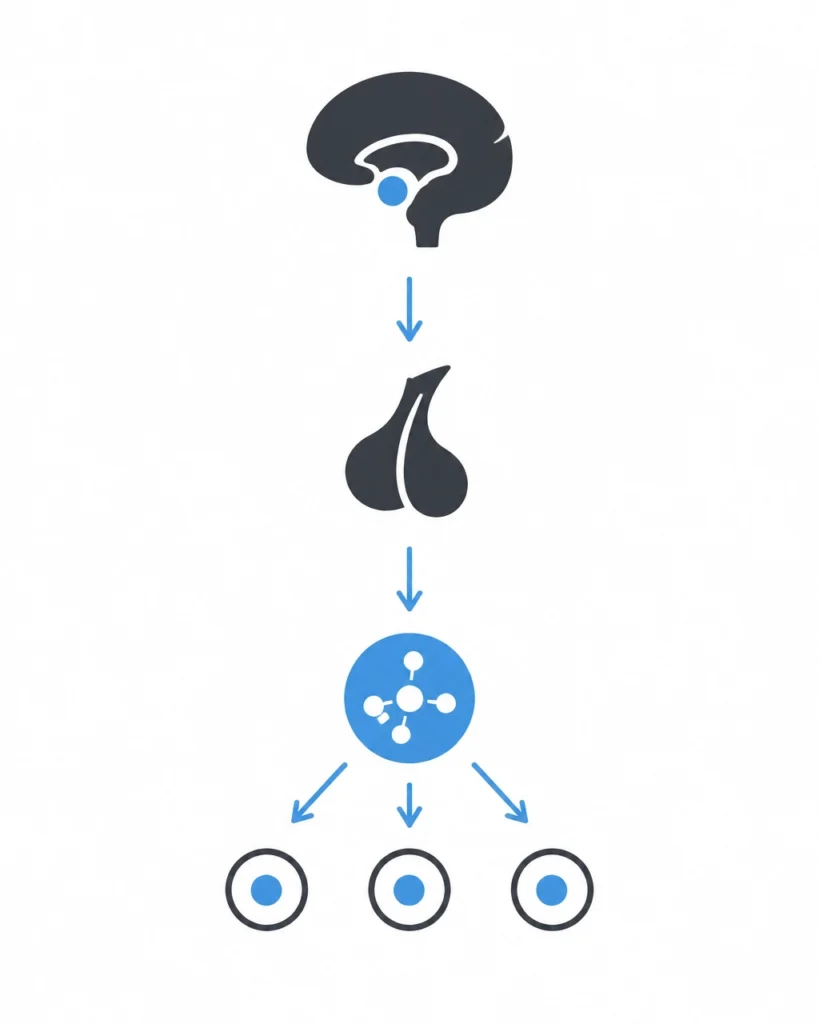
Growth hormone (GH) is released by the pituitary gland. Its release is influenced by signals from the brain and other hormones. Some secretagogues act on pathways involved in this process. CJC-1295 is a synthetic peptide related to growth hormone-releasing hormone. Ipamorelin acts on the ghrelin receptor, which is also involved in GH release.
The term human growth peptides is used informally in some online discussions. It does not identify a single standardized therapy, establish quality, or indicate FDA approval. Likewise, a product described as a “secretagogue” should not be assumed to be safe, effective, or appropriate for an individual.
These substances are distinct from synthetic HGH. Los Angeles Peptides Clinic does not imply that secretagogues are HGH, and this article is not an offer or recommendation to use either. For information about clinical services, see the clinic’s peptide therapy overview.
What does the evidence show?
Research on CJC-1295 includes a small, short-term study in healthy adults. It reported increases in GH and IGF-1, a hormone influenced by GH. Those measurements show a biological response; they do not demonstrate that the peptide improves healthspan, prevents age-related illness, or produces reliable changes in physical function. The study was not designed to answer those longer-term questions. Read the study.
Evidence for ipamorelin is limited for the uses commonly promoted online. FDA reviews have raised concerns about gaps in available safety data, including for subcutaneous use. Review by FDA or an advisory committee is not FDA approval. For updates and background on compounding-related evaluations, consult the FDA’s information on bulk drug substances used in compounding.
More broadly, research on GH and secretagogues in normal aging has not established a clear basis for routine use as an anti-aging intervention. Short-term changes in hormone levels or other measures are not proof of meaningful long-term benefit. Review the research on GH secretagogues and normal aging.
For adults over 35, symptoms such as reduced energy, poor sleep, slower training recovery, and changes in body composition can have many possible causes. Age alone does not establish a hormone deficiency. A clinician can help assess symptoms and determine whether established testing or treatment is appropriate.
Risks and medical considerations
Changing GH and IGF-1 signaling may affect more than a single lab result. Potential concerns discussed in medical literature include fluid retention, swelling, joint discomfort, headaches, and changes in glucose regulation. The extent of risk is not fully characterized for these peptides, particularly with longer-term use. An increase in a hormone marker is not automatically beneficial.
Before considering any hormone-related therapy, discuss your medical history, current medications, and goals with a licensed clinician. Depending on your situation, an evaluation may include a review of glucose or IGF-1 results and other relevant health information. A clinician should determine which assessments are appropriate and how follow-up would work.
Mention any history or concern that could affect the safety of hormonal stimulation, such as diabetes or prediabetes, sleep apnea, or active cancer. This is a reason for individualized medical review, not a statement that these peptides cause cancer or that one lab result can establish suitability. Do not use a research product or change prescribed HRT or TRT based on online advice.

Compounded prescriptions and research chemicals are not the same
A compounded prescription is prepared by a pharmacy for a patient under a clinician’s direction, when applicable legal requirements are met. Compounding is not the same as FDA approval: the FDA does not verify the safety, effectiveness, or quality of compounded drugs before they are marketed. Pharmacy licensing or a “503A” or “503B” label does not mean that every substance or formulation may be compounded in every circumstance. See FDA’s explanation of compounded drugs.
CJC-1295 and ipamorelin must be discussed as compounded, physician-prescribed therapies only, and only where a clinician determines that a lawful pathway applies. Their compounded status does not make them FDA-approved, establish that they are appropriate, or guarantee an outcome. Product availability and prescribing decisions depend on clinical review and applicable requirements.
Gray-market “research chemicals” are a separate category. Products sold online for research purposes are not a substitute for a prescription, clinician review, or pharmacy quality controls. Claims such as “research grade” do not confirm that a product is suitable for human use. Do not buy or inject products from unverified websites or use them without medical supervision.

Questions to ask before considering peptide therapy
If you are researching growth hormone secretagogues in Los Angeles, use a medical consultation to clarify the basics. Ask:
- Is there a diagnosed medical indication, or is the discussion about general wellness?
- What is known, and not known, about the specific compound and formulation?
- Is a legal, patient-specific compounding pathway available for this prescription?
- What medical history, lab work, follow-up, and potential risks are relevant to me?
- Are there FDA-approved or other established options that better fit my situation?
These questions can be useful whether you live in Beverly Hills, Venice Beach, Hollywood, Encino, Calabasas, Downtown Los Angeles, Brentwood, Manhattan Beach, Culver City, Studio City, Santa Monica, Malibu, Pacific Palisades, the San Fernando Valley, Burbank, or Pasadena. The term peptide therapy Los Angeles may describe a local service, but it does not establish clinical suitability or regulatory status.
Los Angeles Peptides Clinic services
Los Angeles Peptides Clinic offers access to doctor-prescribed programs for weight loss GLP programs, performance and repair therapy, longevity and anti-aging, wellness, and HRT and TRT. Services include secure online intake, blood work through Los Angeles-area diagnostics hubs and local labs, review by California board-certified clinicians, and a HIPAA-compliant portal. HSA/FSA eligibility depends on the plan and applicable requirements. The clinic describes program care as included in the price and offers free, discreet two-day shipping after pharmacy fulfillment, where applicable. Prescriptions, when appropriate and legally permitted, are sourced through U.S.-licensed 503A pharmacies or FDA-registered 503B outsourcing facilities. Eligibility, testing, availability, and shipping details vary by program. Learn more about how the clinic’s online care process works.
Contact
Los Angeles Peptides Clinic
1575 Westwood Blvd., Ste 302
Los Angeles, CA 90024
https://losangelespeptidesclinic.com
info@losangelespeptidesclinic.com
(310) 945-2696
Educational disclaimer: This article is for general educational purposes only and is not medical advice, diagnosis, or a recommendation to begin or change treatment. Peptide therapies discussed here are not FDA-approved to treat, cure, or prevent any disease. Compounded medications are not FDA-approved, and a prescription does not guarantee that a therapy is appropriate or effective. Discuss personal medical questions with a qualified clinician.